Equestrian Order of Saint Sergius
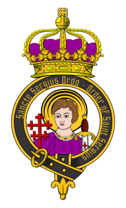
Saint Sergius (died c. 303, Risafe, Syria; feast day October 7) was among the earliest authenticated and most celebrated Christian martyrs, commemorated in the Eastern and Western churches. Christian desert nomads regard Sergius as their patron saint and the Sovereign Imperial and Royal House of Ghassan. Early martyrologies record that Sergius was an officer in the Roman army on the Syrian frontier. He was supposedly a favorite of the Roman emperor Maximian until he refused to sacrifice to the pagan god Jupiter because he was Christian. Maximian demoted Sergius, ordering him to be costumed in women’s dress and marched through the streets. He was then sent to Risafe (now a city in ruins in central Syria), scourged, and boards nailed to Sergius’s feet. He was forced to walk to the place of his beheading. Considerable posthumous homage has been paid to the martyr. In 431, Alexander, metropolitan of Hierapolis, restored the church over Sergius’s grave, and shortly afterward, Risafe became a bishopric. The Byzantine emperor Justinian I changed the name of Risafe to Sergiopolis, making it an archdiocese. In honor of Sergius, he built churches in Constantinople (now Istanbul) and at Acre in Palestine. The church at Risafe became famous in the East as a major pilgrimage site. Sergius and his companion in martyrdom, Bacchus, were designated protectors of the Byzantine army, and numerous Eastern sanctuaries and churches were subsequently dedicated to them. Their veneration is old, and a mass ascribed to Pope Gelasius I is assigned to them. The Royal Ghassanids were an Arab dynasty that ruled several realms from the third through the eighteenth centuries of the Common Era. Even though not organized in chivalric orders, per se, like their later European counterparts, the Ghassanid knights used to fight under the banners of Christ Pantocrator and Saint Sergius. The Ghassanids were the first defenders of Christianity in history to incorporate what's known today as a "code of chivalry" (originated from the Arab concept of "Muru’a"), which means bravery in war, hospitality, respect for women and honor, and protection of the weak and the orphans. Thus, Ghassanid chivalry developed in the sixth century of the Common Era and was spiritualized by Christianity, bringing it close to the Christian version of chivalry in medieval Europe. Despite being unknown in Christian chivalry, the Ghassanids' commitment to Christian chivalry is one of the ideals they developed and tried to uphold, especially during war. The Royal Ghassanids created this Order to perpetuate the legacy of Christian chivalry. The Equestrian Order of Saint Sergius is a modern chivalric and international community organized under the Sovereign Imperial and Royal House of Ghassan, and the members of the Order provide support to the Sovereign Imperial and Royal House of Ghassan for its charitable and cultural projects. The Order is non-religious and temporal, sovereign in its affairs, and subjected only to the Head of the Sovereign Imperial and Royal House of Ghassan. The Order shall not be subjected to religious affiliation, hierarchy, or denomination while maintaining its not-for-profit educational corporate status.
Website: Equestrian Order of Saint Sergius
Founded: 29 April 2023, Memorial of Saint Catherine of Siena
Maximum Number of Members at Any Time: Unlimited
Ranks and Post-nominals: Of the ranks: Knight/Dame (Faris/Farisa) (K/DSS); Knight/Dame (Faris/Farisa) Commander (K/DCSS); Grand Knight/Dame (Faris/Farisa) Commander (GK/DCSS); Knight/Dame (Faris/Farisa) of the Cross (K/DGCSS); Grand Knight/Dame (Faris/Farisa) of the Collar (GColSS); Inheritable Banner Knight/Dame of Risafe (Albarunitaj, البارونيتاج.) Of the Honorary ranks, any of the above ranks may be bestowed by the Grand Master to particular heads of state, heads of royal houses, ecclesiastical leaders, and so on. The honorary members of the Order are not bound to rules and regulations and are not members of any priory or commandry. There are no styles, titles, or post-nominals for these ranks.
Heraldic Privileges: By the right and privileges conferred through Letters Patent, the Knights and Dames of the Order have a Royal Warrant to use particular heraldic devices related to this Order and the Royal House. The Chancellery will provide a heraldry guide. As is the custom of other Royal Houses worldwide, a member shall submit a copy of their arms to the Chancellery for review if the Knight or Dame seeks to adopt the Royal House and Order's particular heraldry devices. With the Chancellery’s approval, the achievement will be registered on the Royal House’s Roll of Arms, which may be published and made public. With the Knight or Dame’s achievement recorded by the Chancellery, they may register their arms with any registries. Members of the second class may use the likeness of their medal suspended from their escutcheon as decorations. Members of the first class may use the likeness of their medal suspended from their escutcheon as decorations and encircle their arms with the Garter of the Order. A Knight or Dame of the Grand Cross may also include the coronet of a knight on the helmet instead of a torse or the coronet of a knight in place of a helmet. A Knight or Dame of the Grand Collar may also include heraldic supporters besides those as mentioned earlier.
Courtesy titles: The Style, Title, and Address of the Knight or Dame are customary within the Royal House of Ghassan. Style, title, and address may or may not be recognizable under the laws and statutes of the member’s place of citizenship, and the customary and lawful practices of said places should guide members. Letters Patent shall issue the title and honor. A Brevet shall assign rank and office appointments. The Grand Master issues these through the Chancellery. This Order does not confer nobility upon the member of any rank. The title and honor of the Order are not inheritable. Knights and Dames (Faris and Farisa) of the second-class ranks are entitled to the courtesy style, “The Honorable,” followed by the title “Faris” or “Farisa” (or “Sir” and “Dame”), the member’s name followed by the appropriate post-nominals. Therefore, the full name, title, and style of a holder of the knight is “The Honorable, Faris/Sir First Name Middle Name Second Middle Name [if any] Surname, KSS”. Knights and Dames (Faris and Farisa) of the first-class ranks are entitled to the courtesy style of “His/Her Excellency,” followed by the title of “Faris” or “Farisa” (or “Sir” and “Dame”), name, and the appropriate post-nominals. Therefore, the full name, title, and style of a holder of the dame is “Her Excellency, Farisa/Dame First Name Middle Name Second Middle Name [if any] Surname, GColSS”. Suppose a particular recipient's Letters Patent or Brevet contains a different style, title, and address than the above. In that case, the Letters Patent or Brevet will triumph only for that particular recipient. The courtesy title for the lawful spouse of a Knight is “Lady” or of a Dame is “Mister.” Children of a member of the Order have no courtesy titles.
Current members of the Order in Good Standing (as of 11 March 2026).
Khalil, Mohiba
Xavier, Rute Miranda
Silva, Inês Azevedo
Polk, Laura
Yiu, Nathan
Caudill, Jason
Said-Zammit,Geroge Alexander
Da Silva Carneiro, Leandro Fabricius
Parisi, Gabriel Adriano
Rocha, Guilherme
Cirilo Patrizio, Loffredo
Khalil, Rashid Allaham
Luk, Lewis Tei
Boyd, Christian Dominic
Ma, Kenny
Tsang, Wai Chun Marianna
Chang, Benson Sun Bun
Cummins, MD, LTC Christopher Marascalco
Chan, Gary Chung Kuo
Khlkevich, Oleg
Arbeen, Mark
So, Albert Man Kit
Chan, Kelvin Tak On
Kraft, Karen
Yeung, Libra Sai Chong
Oswalt, Rev. Fr. Matthew Price
Harper, Jackson Theodore
Boyd, Richard Allen
Nassar, Fr Nadim
Calçada Loureiro, Nuno Alexandre de Oliveira
Lewis, Denice D.
Conceição Martins Barbosa, Teresa da
Pinho Marques Costa, Letícia Milhinha de
Sousa Lima, Armindo Fernando de
Rabaça de Almeida, Marco Alexandre
Vidal Santos, José Miguel
Vilar Martins Gomes, Bruno Miguel
Santos Brandão, David João dos